
Quick answer
To size a 24V DIN rail power supply, add up the continuous current of every 24V load in the cabinet, multiply by 1.25, and choose the next standard size (2.5 / 5 / 10 / 20 / 40 A). For a typical small machine panel that lands at roughly 3.5 A of load, so a 24 V / 5 A unit is the right choice.
Then protect the 24V rail properly: feed each branch through a fuse terminal block, land earth on PE terminal blocks, and add a DC UPS if one second of downtime costs more than the module.
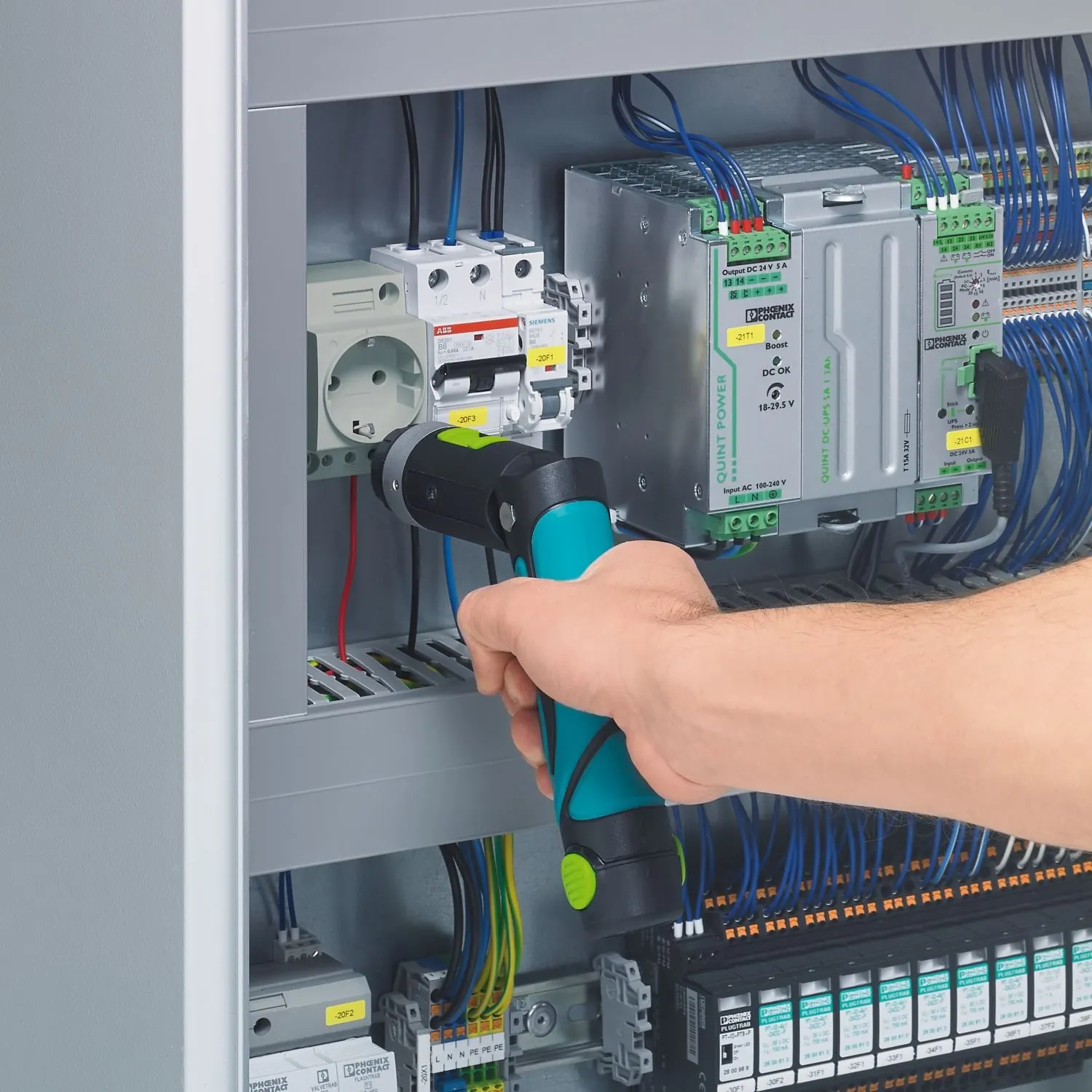
If you build panels or export machinery, you already know where troubleshooting starts when a control cabinet misbehaves: the 24V DIN rail power supply. This guide walks through sizing, boost reserves, DC UPS backup and the terminal block layout that keeps a 24V rail safe and serviceable.
1. Why the Power Supply Decides Your Cabinet Uptime
Every device in the panel hangs on one 24V DC rail: the PLC, remote I/O, HMI, sensors, relay coils and the industrial Ethernet switch. An undersized or unstable supply rarely fails loudly. Instead it produces random PLC resets, flickering communication and unexplained downtime that costs far more than the money saved on a smaller unit.
The cabinet in the photo above shows the architecture we recommend: branch miniature circuit breakers protect the input, a wide-range supply converts 100–240 V AC to regulated 24 V DC, a DC UPS buffers dips and outages, and DIN rail terminal blocks distribute protected power to each load.
2. How to Size a 24V DIN Rail Power Supply
Work from a load list, not from habit. Add the continuous current of every 24V consumer, apply 25% headroom, then select the next standard output class.
| 24 V load | Continuous current |
|---|---|
| PLC + I/O modules | 0.8 A |
| 7″ HMI panel | 0.5 A |
| 20 × proximity sensors | 1.0 A |
| Relay & contactor coils | 0.7 A |
| Industrial Ethernet switch | 0.5 A |
| Total continuous load | 3.5 A |
| × 1.25 headroom → | ≈ 4.4 A → choose a 24 V / 5 A unit |
3. Power Boost, Dynamic Boost and Selective Fuse Breaking
Standard sizing does not cover switching events. Premium ranges such as Phoenix Contact QUINT POWER provide Power Boost, a continuous reserve of about 1.25 × nominal current, so heavier loads run without oversizing the unit.
They also deliver a dynamic boost — a 12 ms pulse of up to 6 × nominal current. That pulse is what allows a faulty branch to trip its own miniature circuit breaker (selective fuse breaking) instead of collapsing the entire 24V bus. In practice: one shorted sensor no longer blacks out the whole machine.
4. Wide-Range Input, Efficiency and Derating
- Wide-range input (100–240 V AC). One part number works worldwide — no transformers, no regional variants in your spare-parts list.
- Read the derating curve. Check what the unit delivers at 40 °C, 55 °C and 60 °C ambient, not just the headline figure at 25 °C.
- Efficiency is cooling. Less heat means smaller enclosures, longer capacitor life and a lower energy bill over the machine’s lifetime.
5. Diagnostics: DC-OK Contact and Preventive Monitoring
A DC-OK relay contact — visible on the front of the unit in the photo — lets the PLC detect undervoltage immediately. Preventive function monitoring goes one step further and warns you before the output disconnects, turning a surprise stop into a planned maintenance ticket.
6. Backup Power: Adding a QUINT DC UPS
Grids that also feed cranes, welders and large drives are full of voltage dips. Without buffering, a 100 ms dip resets the PLC and scraps the batch in progress. The QUINT DC UPS mounted beside the power supply above bridges those dips, keeps controllers and networks alive, and enables a controlled shutdown if the outage lasts longer.
Ultracapacitor-based DC UPS modules are maintenance-free and tolerate far more charge cycles than battery-based systems — the right default when the required buffer is seconds to a few minutes. For longer ride-through, pair the module with a battery unit sized to your shutdown time.
7. Distributing the 24V Rail With DIN Rail Terminal Blocks
A well-sized supply still fails the inspection if the 24V rail is distributed with loose jumper wires. This is where the terminal block layout earns its keep:
- Fuse terminal blocks protect each branch individually, so a fault on one circuit never takes down the others — and swapping a fuse takes seconds, with no rewiring.
- PE terminal blocks (green-yellow, grounding) give protective earth a dedicated, clearly identified landing point instead of a shared screw on the backplate.
- Feed-through and multi-conductor blocks split one source into several protected branches in a compact footprint.
- Plug-in bridges distribute the same potential across blocks without jumper wires that work loose under vibration.
- End clamps and marker strips keep the assembly mechanically locked and every wire identified — the numbered markers (-2D F1, -2D F2 …) you can see in the photo above.
If your panel build is moving to tool-free wiring, see our hands-on guide to push-in terminal blocks, or the full DIN rail spring terminal block buyer’s guide for connection technology comparisons.
8. Installation Checklist From the Panel Shop Floor
- Torque matters. Use a torque-controlled screwdriver, as in the photo; typical 2.5 mm² terminals need roughly 0.5–0.6 N·m. Loose connections heat up, overtightened housings crack.
- Protect the input. Feed the supply through a correctly rated miniature circuit breaker with a C-curve characteristic — the ABB and Siemens 5SY-style breakers visible above.
- Separate AC from DC. Route 230 V AC away from 24 V DC and signal cables; where they must cross, do it at 90°.
- Respect derating. Mount supplies vertically, follow the side clearance in the datasheet, and never block convection slots.
- Label everything. Numbered markers on both ends pay for themselves the first time someone troubleshoots at 2 a.m.
- Commission in order. Bond PE first, check the DC-OK LED, and measure the output voltage before energizing the loads.
9. Certifications to Match Your Export Market
North American panels: UL 508 or UL 61010 listed. Europe: CE (UKCA for the UK). Hazardous locations: ATEX / IECEx. Marine and offshore: DNV, GL or ABS. Always match certificates to where the machine will run, not just where it is built.
The same logic applies to the wiring components around the supply: our DIN rail terminal blocks are produced under ISO9001 and ISO14001 systems and certified to UL, cUL, TÜV, CE, VDE, RoHS and RCM, so one panel can ship to several markets without a component swap.
10. 24V DIN Rail Power Supply FAQ
How do I size a 24V DIN rail power supply?
Add up the continuous current of all 24V loads in the cabinet, multiply by 1.25 for headroom, then select the next standard output size: 2.5, 5, 10, 20 or 40 A. Finally check that the largest inrush load, such as a contactor coil or DC motor, can start without pulling the rail down.
What is Power Boost and why does it matter?
Power Boost is a continuous current reserve of about 1.25 × nominal current that covers heavier loads without oversizing the unit. Premium ranges such as Phoenix Contact QUINT POWER also deliver a 12 ms pulse of up to 6 × nominal current, which trips the faulty branch breaker on a short circuit instead of collapsing the whole 24V bus.
Do I need a DC UPS in my control cabinet?
Yes if a single second of downtime costs more than the module. A DC UPS bridges voltage dips and short outages, keeps PLCs and industrial networks alive, and enables a controlled shutdown during longer failures, which prevents data loss and scrapped batches.
How should I distribute 24V inside the cabinet?
Feed the load side through fuse terminal blocks so each branch is individually protected, land protective earth on green-yellow PE terminal blocks, and use plug-in bridges to distribute the same potential without loose jumper wires. This keeps the panel serviceable and matches how inspectors expect a cabinet to be built.
Can I connect two power supplies in parallel for redundancy?
Only with decoupling or redundancy diode modules, which isolate a failed or sagging unit so it cannot pull down the healthy one. Paralleling outputs directly can cause circulating currents and silent failures that only show up during an outage.
Which certifications should a control cabinet power supply have?
For North American panels look for UL 508 or UL 61010 listing, CE or UKCA for Europe, ATEX and IECEx certificates for hazardous areas, and DNV, GL or ABS for marine cabinets. Always match the certificates to the destination market of the machine, not just the build location.
Build the 24V Distribution With WCK DIN Rail Terminal Blocks
WCK Electrical manufactures DIN rail terminal blocks in-house — push-in spring cage, screw type and double-deck series, plus fuse, PE, feed-through, multi-conductor blocks, plug-in bridges and marker strips. Send us your panel layout or BOM and our engineers will confirm the rail distribution and quote within 24 hours.