
Home / Blog / DIN Rail Spring Terminal Blocks Guide
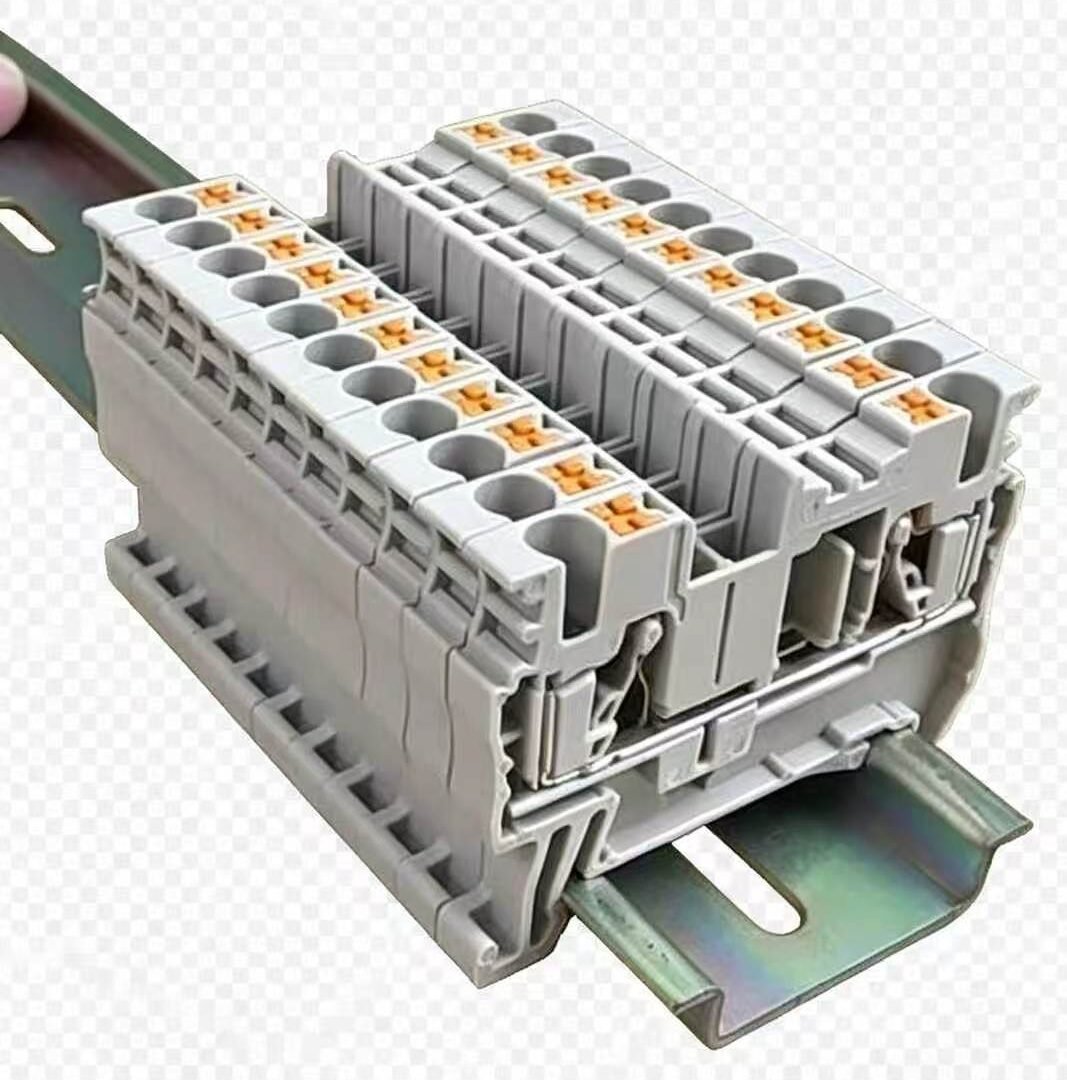
Table of Contents
- What Are DIN Rail Spring Terminal Blocks?
- How Spring-Cage Technology Works
- Key Specifications & Ratings
- Spring vs. Screw vs. Push-In
- Common Types and Configurations
- How to Choose the Right Terminal Block
- Installation Best Practices
- Common Applications
- Frequently Asked Questions
DIN rail spring terminal blocks have become the connection standard for modern industrial electrical panels, switchgear, and automation systems. Unlike traditional screw terminals, spring-cage and push-in terminal blocks deliver faster wiring, vibration-resistant connections, and maintenance-free reliability that OEMs and system integrators demand.
In this comprehensive guide, we cover everything procurement engineers and panel builders need to know about spring-cage DIN rail terminal blocks — from how the technology works to sizing, ratings, and selecting the right configuration for your project.
What Are DIN Rail Spring Terminal Blocks?
A DIN rail spring terminal block is an electrical connector designed to mount on a standardized 35mm top-hat DIN rail (EN 60715). It uses a spring-cage clamping mechanism — rather than a screw — to secure the wire, creating a gas-tight electrical connection that resists vibration, corrosion, and thermal cycling.
The key components include:
- Polyamide housing (PA66) — V-0 flame retardant, rated -40C to +105C
- Spring-cage clamp — Stainless steel or nickel-plated steel spring for constant contact pressure
- Current bar — Tin-plated copper or brass for high conductivity
- Actuation lever or push button — Orange lever for tool-free wire release
- DIN rail foot — Snap-on mounting for 35mm rail with integrated end stop
Industry Standard Compliance
Quality DIN rail terminal blocks should carry IEC 60947-7-1 (feed-through), UL 1059, and CSA C22.2 No. 158 certifications. Always request test certificates when sourcing from terminal block manufacturers.
How Spring-Cage Technology Works
The spring-cage mechanism in a DIN rail terminal block operates on a simple but highly reliable principle:
- Insertion: The stripped wire is pushed into the terminal opening. In push-in variants, the spring opens automatically as the wire enters. In spring-cage variants, a tool or actuation lever opens the clamp.
- Clamping: The spring applies constant pressure against the current bar, compressing the wire strands into a gas-tight cold weld that prevents oxidation.
- Retention: The spring maintains uniform contact force across the wire cross-section, even under vibration, thermal expansion, and contraction cycles.
- Release: The orange lever is pressed to open the spring, allowing the wire to be removed without tools.
This design eliminates the most common failure mode of screw terminals — torque-dependent loosening. Independent studies show spring connections reduce field failure rates by up to 80% compared to improperly torqued screw terminals.
Pro Tip: Wire Preparation
For optimal spring-cage performance, strip wires to the exact length specified in the datasheet (typically 10-12mm). Over-stripped wires can short adjacent terminals; under-stripped wires reduce contact area and increase resistance.
Key Specifications & Ratings
When specifying DIN rail spring terminal blocks for a project, these parameters determine compatibility and safety:
| Specification | Typical Range | What It Means |
|---|---|---|
| Wire Cross-Section | 0.08 mm2 – 240 mm2 | Conductor size the block accepts |
| Rated Voltage | 250V – 1000V | Maximum system voltage (AC or DC) |
| Rated Current | 10A – 232A | Continuous current without overheating |
| Surge Voltage | 6kV – 10kV | Withstand rating per IEC 60947-7-1 |
| Temperature Range | -40C to +105C | Operating ambient temperature |
| Pollution Degree | PD 2 or PD 3 | Environmental contamination level |
| Mounting Rail | 35mm x 7.5mm or 15mm | Standard EN 60715 top-hat DIN rail |
| Housing Material | PA66 (V-0) or PBT | Flame retardant, halogen-free options available |
| Connection Type | Spring-cage / Push-in | Tool-free or tool-assisted clamping |
Always consult the manufacturer’s datasheet for exact ratings. Terminal blocks shown in the image above are rated for 500V / 800V and 16A to 41A, typical for industrial control applications.
Spring vs. Screw vs. Push-In: Comparison
Not all connection technologies are equal. Here’s how the three dominant terminal block types compare for industrial applications:
| Feature | Screw Terminal | Spring-Cage Terminal | Push-In Terminal |
|---|---|---|---|
| Installation Speed | Slow (torque wrench) | Medium (tool for release) | Fast (tool-free) |
| Vibration Resistance | Low | High | High |
| Retorquing Required | Yes | No | No |
| Wire Reconnection | Full retorque | Lever release & reinsert | Pull out & push back |
| Cost per Position | Lowest | Medium | Medium-High |
| Best For | Static, low-vibration panels | Heavy machinery, railways | High-density automation |
For OEMs building control panels for export, spring-cage and push-in terminals offer a significant competitive advantage: they reduce installation labor by 50-60% and eliminate warranty callbacks due to loose connections.

DIN Rail Spring-Cage Terminal Block Series
Push-in connection with tool-free release. Rated 500V / 24A. 0.5-4 mm2 wire range. PA66 V-0 housing. Compatible with 35mm DIN rail.View Specifications & Pricing
Common Types and Configurations
DIN rail terminal blocks come in multiple configurations to solve different wiring challenges. Here are the most common types used in industrial applications:
Feed-Through Terminal Blocks
The most common type — a simple pass-through connection from one side to the other. Feed-through terminal blocks carry the main power or signal path through the panel. The image at the top of this article shows a double-row feed-through configuration, maximizing circuit density.
Double-Deck Terminal Blocks
Double-deck blocks stack two independent circuits vertically, effectively doubling density without increasing rail length. This is the configuration shown in the product image — two levels of spring-cage terminals share a single DIN rail footprint, ideal for PLC I/O panels and distribution boards where space is constrained.
Double-Deck Advantage
A standard 1-meter DIN rail holds roughly 100 single-level terminal blocks. With double-deck blocks, the same rail accommodates 200 circuits — a 50% reduction in panel footprint and wiring duct length.
Fused & Disconnect Blocks
These specialized variants integrate protection or isolation functions directly into the terminal block:
- Fused terminal blocks — Accept 5x20mm or 6.3x32mm cartridge fuses for circuit protection
- Knife disconnect blocks — Allow circuits to be opened for testing without removing wires
- Component blocks — Mount diodes, resistors, or LEDs for signal conditioning
How to Choose the Right Terminal Block
Follow this decision framework when specifying terminal blocks for a project:
- Define electrical parameters — Calculate maximum voltage, continuous current, and prospective short-circuit current. Select a terminal block with at least 25% headroom on voltage and current ratings.
- Determine wire range — Match the terminal block’s rated cross-section to the smallest and largest wire gauges in the design. Spring-cage blocks typically cover 0.08 mm2 to 35 mm2 per tier.
- Assess environmental conditions — High-vibration applications (railway, marine, heavy machinery) demand spring-cage or push-in connections. Standard industrial panels can use any type.
- Calculate density requirements — If panel space is limited, consider double-deck or triple-deck configurations. Verify that wire bending space complies with IEC 61439-1.
- Specify accessories — End brackets, partition plates, marking tags, and jumpers must be compatible with the terminal block series. Incompatible accessories are a common procurement error.
- Verify certifications — Export projects may require UL, CSA, or specific marine approvals (DNV, BV, LR). Request certificates early in the sourcing process.
Common Specification Error
Do not mix terminal block series from different manufacturers on the same DIN rail unless verified compatible. Rail height, foot geometry, and pitch vary between brands, causing misalignment and unsafe gaps.
Installation Best Practices
Even the best terminal block fails if installed incorrectly. Follow these guidelines:
- Strip length: Use the strip gauge printed on the terminal block housing. Incorrect strip length is the #1 cause of poor connections.
- Torque: For spring-cage blocks, no torque is required — but verify the wire is fully inserted until the stop.
- Ferrules: Fine-stranded wires (class 5 or 6) should use crimped ferrules to prevent strand splaying. Coarse-stranded wires (class 2) can connect directly.
- End stops: Always install end brackets at both ends of a terminal block assembly to prevent sliding under short-circuit forces.
- Marking: Label every terminal position before wiring begins. Retroactive marking is 3x slower and more error-prone.
- Wire routing: Maintain proper bend radius and strain relief. Do not rely on the terminal block to support wire weight.
Common Applications
DIN rail spring terminal blocks serve across virtually every industrial sector:
- Control panels & switchgear — PLC I/O wiring, motor control centers, power distribution
- Building automation — HVAC controllers, lighting panels, energy management systems
- Renewable energy — Solar combiner boxes, wind turbine control cabinets, battery storage systems
- Transportation — Railway signaling, marine electrical panels, EV charging infrastructure
- Process automation — Oil & gas control systems, water treatment panels, pharmaceutical manufacturing
- Machinery OEM — Packaging machines, CNC controls, robotic cells, conveyor systems
In each application, the choice between screw, spring-cage, and push-in depends on vibration exposure, maintenance access, and installation labor costs.
Need a Custom Terminal Block Solution?
We manufacture DIN rail terminal blocks for OEMs, panel builders, and system integrators worldwide. Custom colors, markings, and packaging available.
Request a QuoteBrowse All Products
Frequently Asked Questions
What is a DIN rail spring terminal block?
A DIN rail spring terminal block is an electrical connector that mounts on a standardized 35mm DIN rail. It uses a spring-cage or push-in mechanism to secure wires without screws, providing reliable gas-tight connections for industrial control panels, switchgear, and automation systems.
What wire sizes do DIN rail terminal blocks support?
DIN rail terminal blocks typically support wire sizes from 0.08 mm2 (28 AWG) up to 240 mm2 (500 MCM), depending on the series. Common industrial sizes include 0.5-4 mm2, 0.5-10 mm2, and 2.5-35 mm2. Always check the manufacturer’s datasheet for exact cross-section compatibility.
Are spring terminal blocks better than screw terminals?
Spring-cage terminal blocks offer faster wiring, vibration resistance, and maintenance-free connections compared to screw terminals. They eliminate torque sensitivity, reduce installation time by up to 60%, and maintain consistent contact pressure over the product lifetime. Screw terminals remain cost-effective for lower-vibration, static applications.
What voltage and current ratings do spring terminal blocks have?
Standard DIN rail spring terminal blocks are rated from 250V to 1000V and 10A to 232A, depending on size and series. Most industrial applications use 500V/800V ratings with 16A to 125A current capacity. Always verify IEC 60947-7-1 compliance for your specific application requirements.
Can spring terminal blocks be used in harsh environments?
Yes. High-quality spring terminal blocks use PA66 or PBT housings with V-0 flame retardancy, rated for -40C to +105C. They resist vibration per IEC 60068-2-6, shock per IEC 60068-2-27, and meet IP20 base protection. For outdoor or corrosive environments, additional terminal covers and enclosures are recommended.
Related Articles
Push-In vs. Screw Terminal Blocks: Which Should You Choose?
A detailed comparison of connection technologies for industrial electrical panels. DIN Rail Sizes & Standards Explained Understanding EN 60715, top-hat vs. G-type rail, and how to select the right mounting profile. Terminal Block Wiring Best Practices Strip lengths, ferrules, torque specs, and common mistakes to avoid in panel assembly. How to Select Terminal Blocks for Control Panels A step-by-step guide for specifying terminal blocks in PLC, MCC, and distribution panels.